
Off-Road Suspension Parts OEM ODM: The Complete Sourcing Guide for Manufacturers and Brands
Quick Answer
Off-road suspension parts OEM ODM means contract manufacturing for parts such as control arms, lift kits, shock mounts, and suspension links. A buyer can supply a complete design (OEM), or the manufacturer can develop the design together with the buyer from a brief (ODM). Production usually starts with CNC machining or high-tensile steel forming, using materials such as A36 steel plate and heavy-wall DOM seamless tubing. Manufacturers then weld, finish, and test each part against automotive-grade standards. Brands choose this model because it gives them design support and tooling capability. As a result, they reach volume production without building their own factory for demanding off-road parts.
What Off-Road Suspension Parts Include
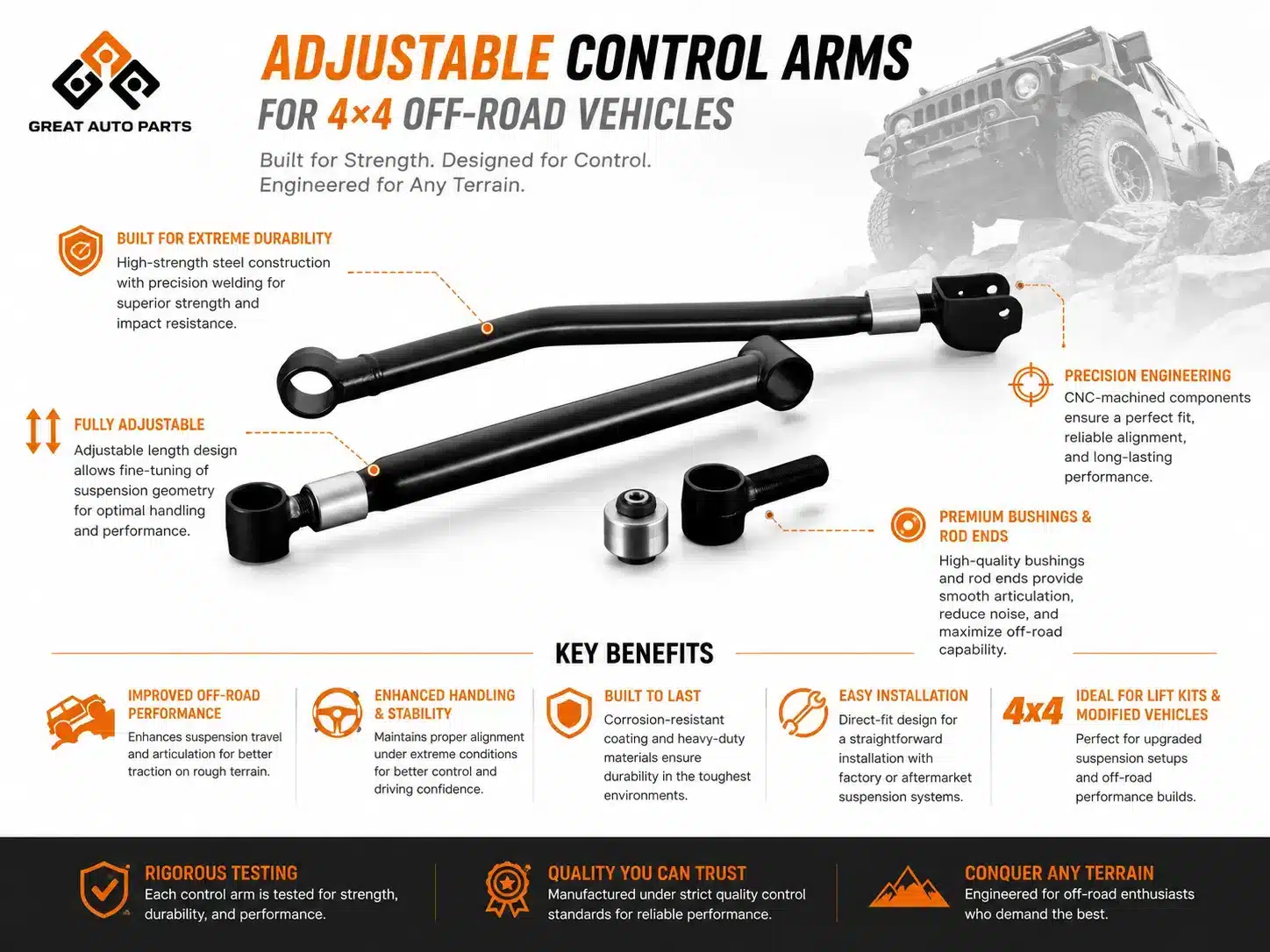
Off-road suspension systems combine several connected components. Each part must handle higher loads, greater articulation, and rougher terrain than standard on-road driving requires.
- Control arms — connect the suspension to the vehicle frame while allowing controlled wheel movement
- Lift kits — raise vehicle ride height to accommodate larger tires and greater ground clearance
- Shock absorbers and mounts — manage suspension travel and damping under off-road impact loads
- Suspension links and track bars — maintain axle alignment through extended suspension travel
- Bushings and joints — absorb vibration and allow controlled movement at connection points
OEM vs. ODM: What’s the Difference
| Model | Design Ownership | Best For |
|---|---|---|
| OEM (Original Equipment Manufacturer) | Buyer supplies complete design specifications | Brands with in-house engineering capability |
| ODM (Original Design Manufacturer) | Manufacturer develops design from buyer’s brief | Brands wanting to leverage supplier engineering expertise |
Many off-road parts brands use a hybrid approach instead. They supply core design requirements and vehicle fitment specifications. The manufacturer’s engineering team then refines the geometry, materials, and manufacturability. This approach blends elements of both OEM and ODM collaboration.
Why Brands Choose OEM ODM Sourcing for Suspension Parts
Building in-house manufacturing for automotive-grade suspension components takes a large capital investment. Brands need CNC equipment, forming presses, welding capability, and quality certification. Most off-road parts brands, especially newer or mid-sized companies, cannot justify building this infrastructure themselves.
- Avoids the capital cost of CNC machines, forming presses, and welding equipment
- Provides access to design engineering expertise the brand may not have in-house
- Enables faster time-to-market by leveraging a manufacturer’s existing tooling and process knowledge
- Allows brands to focus resources on product design, marketing, and distribution rather than production operations
Established brands with strong engineering teams often prefer an OEM relationship built around precise specifications. Brands earlier in their product development cycle, on the other hand, tend to benefit more from an ODM partnership, where the manufacturer adds engineering expertise alongside production capability. Either approach can evolve over time. Many brands start with an ODM arrangement, then gradually shift toward tighter OEM specification control as their own engineering team grows.
Manufacturing Process for Off-Road Suspension Parts
Design and Prototyping
Development usually starts with 3D scanning of the existing vehicle suspension geometry, which creates accurate reference models. Engineers then move to CAD design, followed by a design-for-manufacturability (DFM) review. This review covers machinability, tooling access for CNC features, tolerance strategy, and finishing allowances. The DFM step lets manufacturers flag potential production issues before tooling investment begins. As a result, teams avoid costly redesigns after they have already produced physical samples.
Mike, an automotive parts design engineer with 13 years of suspension and steering component experience at Great Auto Parts, sees this stage as where discipline pays off most. Catching a tooling-access problem on a CAD model costs an afternoon of rework. Catching the same problem after machining a first sample, however, can mean re-cutting tooling and pushing a launch date back by weeks. That’s why GAP keeps its design and engineering team closely involved, from the earliest CAD review through final sample approval.
Fabrication Methods
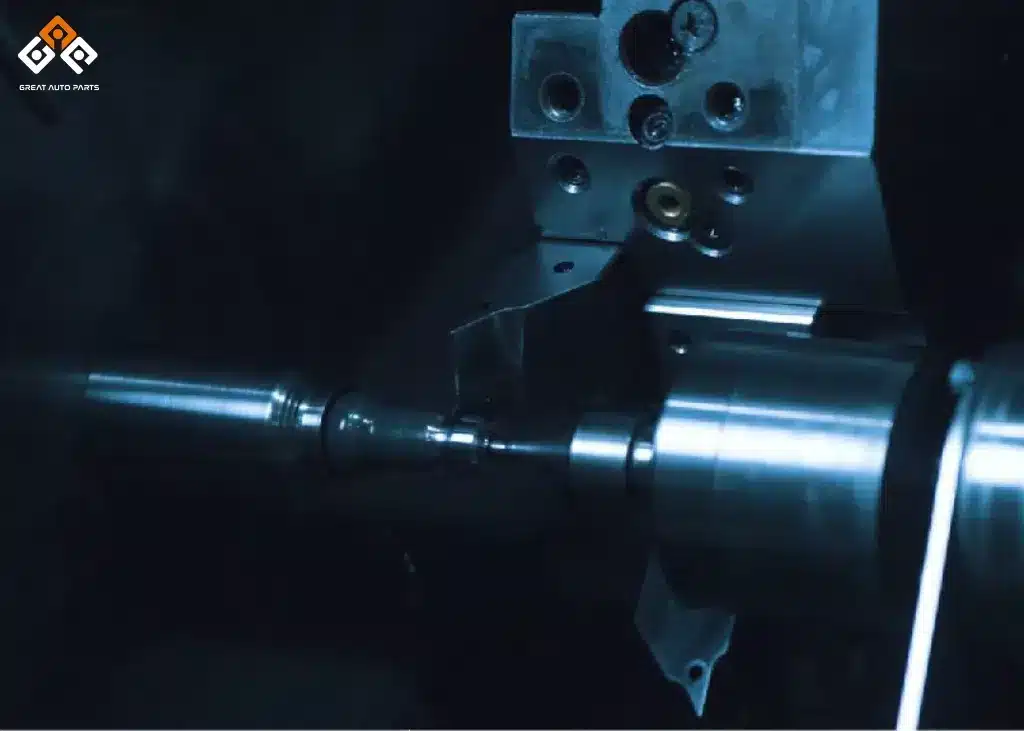
Suspension components typically use one of two fabrication approaches: CNC machining from billet material, or forming and stamping from high-tensile steel plate or tubing. CNC-machined parts tend to be stronger and more compact for the same strength level. Formed or stamped components, on the other hand, usually cost less per unit at higher production volumes. The right choice mainly depends on target price point and production scale.
Welding and Assembly
Multi-piece suspension components, such as control arms and lift kit brackets, require precision welding to join formed or machined sections. Weld quality directly affects the component’s fatigue life under the repeated impact loading typical of off-road use. Certified welding procedures and regular operator qualification checks help keep weld strength consistent across production runs. Otherwise, quality can vary by individual welder skill on any given day.
Finishing and Coating
Finishing methods vary by component and exposure conditions. Cosmetic or moderately loaded surfaces commonly use sulfuric anodizing in set colorways. Components subject to higher wear, however, may need harder finishes, such as hard anodizing or specialized coatings for corrosion and abrasion resistance. Choosing the right finish for each surface, instead of applying one uniform treatment across an entire part, helps balance appearance, cost, and long-term durability.
Common Materials Used
| Material | Typical Use | Why It’s Chosen |
|---|---|---|
| A36 steel plate (1/4″ or thicker) | Control arm brackets, mounting plates | Good weldability and strength at moderate cost |
| DOM (drawn over mandrel) seamless tubing | Control arms, suspension links | Consistent wall thickness and high strength-to-weight ratio |
| High-tensile alloy steel | Load-bearing structural components | Higher yield strength for demanding applications |
| Aluminum alloys | Weight-sensitive components | Reduced unsprung weight where strength allows |
Quality Standards and Certification
Manufacturers commonly build suspension components for automotive-grade applications to recognized quality management standards, such as IATF 16949, which governs automotive parts quality systems. They also carry out material certification and dimensional inspection at each stage of production.
- IATF 16949-certified quality management systems for automotive-grade production
- Material certification confirming steel grade and mechanical properties
- Dimensional inspection against CAD specifications at key production stages
- Weld inspection to confirm joint integrity under fatigue loading
Keeping design, fabrication, welding, and finishing stages within a single facility, or a tightly coordinated supply chain, helps preserve consistent quality oversight throughout manufacturing. It also avoids the variability that comes from multiple disconnected subcontractors. This combined approach simplifies traceability, too, if a quality issue does arise. A team can review a component’s full production history within one organization instead of piecing it together across several independent suppliers.
Testing and Validation Before Production
Fatigue and Load Testing
Off-road suspension components experience repeated high-impact loading far beyond typical on-road conditions. Because of this, prototype parts should go through fatigue and load testing to confirm the design meets its target service life before production tooling begins. Skipping this step risks a nasty surprise: discovering a structural weakness only after parts are already in the field. As Mike puts it, fatigue testing is less about proving a part is strong. It’s more about finding out exactly how the part eventually fails, so the team can design that failure mode out before a customer ever encounters it.
Fitment Verification
Physical fitment testing on the target vehicle platform confirms that dimensional tolerances translate correctly from CAD models to real-world installation. This step catches interference or clearance issues that can be hard to spot from drawings alone, particularly around full-lock steering angles and maximum suspension droop.
Field Testing Under Real Conditions
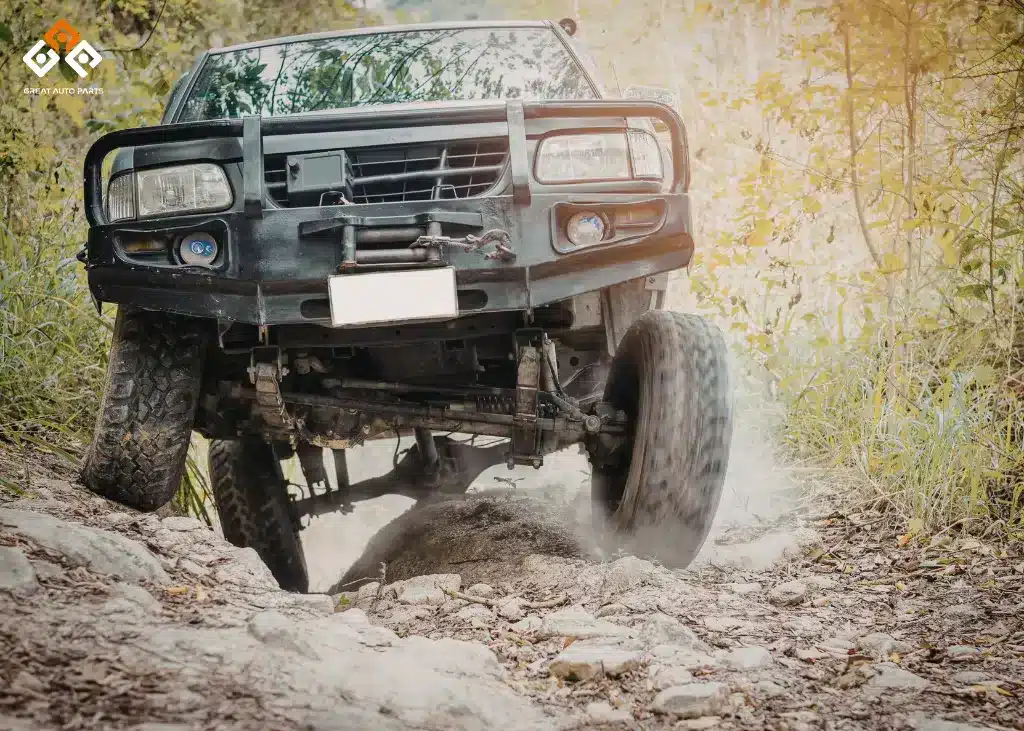
Beyond laboratory validation, many off-road suspension brands also conduct field testing on real-world terrain. This confirms that damping characteristics, articulation, and durability perform as expected under actual driving conditions, since lab testing alone cannot fully copy the combined stresses of real-world off-road use. Field testing also reveals installation and serviceability issues that CAD review or bench testing alone may miss, such as tool clearance for future maintenance or interference with other vehicle components during full suspension articulation.
Packaging and Logistics for Suspension Components
Suspension parts are often heavy, irregularly shaped, and prone to cosmetic damage during shipping. Because of this, packaging design is an important but sometimes overlooked part of the sourcing relationship. Buyers should confirm that their manufacturing partner has experience packaging similar components for the intended distribution channel, whether that means bulk shipment to a distributor or retail-ready packaging for e-commerce orders. Poorly designed packaging can lead to finish damage, bent brackets, or missing hardware during transit. All of these problems generate costly returns and warranty claims, which a modest upfront investment in proper packaging design can largely prevent.
How to Choose an Off-Road Suspension Parts OEM ODM Partner
- Review the manufacturer’s design engineering capability, particularly for ODM projects requiring geometry development from a brief
- Confirm fabrication method (CNC machining vs. forming) matches your target cost and strength requirements
- Request material certifications and quality management system documentation (such as IATF 16949)
- Evaluate prototyping and sample validation timelines before committing to volume tooling
- Clarify minimum order quantities and lead times for both prototype and production runs
- Confirm finishing options (anodizing, coating) match your product’s durability and cosmetic requirements
Customization Options for Off-Road Suspension Brands
| Customization | What It Involves | Typical Buyer |
|---|---|---|
| Vehicle-specific fitment | Geometry engineered for a specific make, model, and year | Brands targeting a defined vehicle platform |
| Lift height variants | Multiple lift height options within one product family | Brands offering tiered product lines |
| Finish and color options | Custom anodizing colors or coating types | Brands with distinct visual branding |
| Private label branding | Manufacturer-produced parts sold under buyer’s brand name | Distributors and retail brands without in-house engineering |
Manufacturers that offer a broad range of these customization options in one relationship give brands an advantage. Brands can expand their product catalog step by step, without qualifying a new supplier for every variant or vehicle platform they add. This approach reduces both the time and quality-control overhead of adding new SKUs to an existing product line.
Common Mistakes When Sourcing Off-Road Suspension Parts
- Selecting a manufacturer based on price without verifying automotive-grade quality certification
- Skipping physical prototype validation before committing to full production tooling
- Underestimating the importance of weld quality inspection for fatigue-critical components
- Assuming all suppliers offer true ODM design support rather than build-to-print manufacturing only
- Overlooking material certification, which can affect both performance and liability exposure
Frequently Asked Questions
Q: What is the difference between OEM and ODM in suspension part manufacturing?
A: OEM manufacturing follows a buyer’s complete design specification, while ODM involves the manufacturer developing the design from the buyer’s brief.
Q: What materials are most common in off-road control arms?
A: A36 steel plate and DOM seamless tubing are widely used for their strength, weldability, and cost balance.
Q: Is CNC machining better than forming for suspension parts?
A: CNC machining generally offers greater strength and compactness, while forming is typically more cost-effective at higher production volumes.
Q: What quality certification should an off-road suspension parts manufacturer have?
A: IATF 16949 is the most commonly referenced automotive quality management certification for this category.
Q: How important is finishing for off-road suspension components?
A: Very — proper anodizing or coating protects against corrosion and wear under the harsh conditions typical of off-road use.
Q: Can a manufacturer help design a new suspension part from scratch?
A: Yes, under an ODM arrangement, though the depth of design support varies by manufacturer and should be confirmed upfront.
Q: What should I request before committing to full production?
A: Physical prototype samples and material/quality certifications should be validated before committing to volume tooling.
Q: Can suspension parts be private labeled under my own brand?
A: Yes — many OEM ODM manufacturers offer private labeling for distributors and retail brands that don’t have in-house engineering teams.
Q: How important is fatigue testing for off-road suspension parts?
A: Very important — these components face repeated high-impact loads, so fatigue testing on prototypes helps confirm long-term durability before production.
Why Work With Great Auto Parts for Off-Road Suspension OEM ODM
Great Auto Parts Industrial Co., Ltd. (GAP) is based in the Taichung Port Science and Technology Industrial Park, Taiwan. The company brings over 30 years of experience in steering and suspension component manufacturing for the global automotive aftermarket.
GAP holds IATF 16949:2016 certification within the scope of CNC machining, and also holds ISO 14001:2015 certification for environmental management. The team carries out material certification and dimensional inspection at each stage of production to keep every batch consistent.
GAP’s product range for off-road and 4×4 suspension and steering applications includes:
- Control arms
- Ball joints and ball joint housings
- Tie rod ends and rack ends
- Sway bar and stabilizer links
- Ball studs and pillow balls
- Bushings and heavy duty suspension arm tubes
Standard production materials include DOM (drawn over mandrel) seamless tubing and aluminum alloys, among others. The team can adjust material selection to match individual project requirements and target vehicle applications.
GAP offers rapid prototyping, with sample completion in as little as 30 working days. For custom OEM ODM development projects, minimum order quantities typically start at 300 pieces per SKU.
GAP backs its products with warranty coverage and offers worldwide air and sea shipping, built on three decades of export experience serving distributors and brands across global markets.
Conclusion
Sourcing off-road suspension parts through an OEM or ODM manufacturing partnership gives brands access to specialized design engineering, fabrication capability, and automotive-grade quality systems, without the capital investment of building in-house production. Selecting the right partner, however, requires evaluating fabrication method, material certification, quality management standards, and design engineering support against the specific component and application. Physical prototype validation remains an essential step, too, before committing to volume production.
As off-road vehicle customization keeps growing as a category, brands need the right manufacturing partner more than ever. A partner that can support both current product lines and future vehicle platform expansion helps a brand scale more efficiently than juggling multiple suppliers across its catalog. That’s why investing time upfront to properly vet a manufacturing partner’s engineering, quality, and testing capabilities pays off across every future product built through that relationship.