
Lifted Truck Control Arm Manufacturing: A Sourcing Guide for Aftermarket Brands
What Does a Lifted Truck Control Arm Manufacturer Do? Quick Answer by Great Auto Parts
A lifted truck control arm manufacturer designs and produces upper and lower control arms engineered specifically to correct the suspension geometry errors introduced when a truck is raised with a lift or leveling kit. Raising ride height moves the control arm’s pivot points outside their original design range, reducing caster angle and pushing ball joints toward the edge of their intended range of motion, which can cause binding, uneven wear, and poor steering feel. A properly engineered lifted-truck control arm restores caster and camber to near-stock specifications, re-angles the ball joint to match the new geometry, and often increases suspension travel — something a stock replacement arm cannot do. For aftermarket brands, the real differentiator isn’t the finished part alone, but the manufacturing partner behind it: one with the precision machining capability, certified process control, and manufacturability feedback to turn your drawing or reference sample into a production-ready, quality-consistent arm.
Why Stock Control Arms Don’t Work on Lifted Trucks
Control arms are originally engineered around the vehicle’s factory ride height, with ball joint angle, pivot geometry, and arm length all calculated for that specific range of suspension travel. Installing a lift or leveling kit changes the geometry the control arm was designed around, even though the arm itself remains physically unchanged.
- Lifting the suspension displaces inner and outer pivot points beyond their designed operating range, introducing geometry errors at full droop and bump
- Factory caster settings typically sit in a narrow positive range, and lift height reduces this angle as pivot points shift relative to the spindle
- Ball joints are engineered for a defined total range of movement, but on a lifted truck they start already rotated partway through that range
- This partial pre-rotation causes binding during compression and concentrates wear on a small portion of the joint’s bearing surface
These geometry errors cannot be corrected through wheel alignment adjustments alone, since alignment settings can only compensate within the range the factory control arm geometry allows — which is exactly why a purpose-built replacement arm, engineered and manufactured to the target lift height, is needed once a truck is lifted beyond a certain height.
As Joe, one of Great Auto Parts’ production engineers with sixteen years in automotive chassis manufacturing, puts it: arms rarely fail in the field because of the steel — they fail because the pivot geometry was copied from a similar-looking part instead of calculated against the actual lift height and vehicle platform. When a brand sends over a competitor’s part to “match,” and the team sections it to measure the ball stud taper against the knuckle angle, the numbers often don’t actually resolve the caster loss being advertised. What changes the outcome is confirming the drawing or sample against the target vehicle’s real geometry before cutting steel for a prototype — a slower first step, but one that saves a redesign after field complaints.
What a Lifted Truck Control Arm Corrects
Caster Correction
Properly engineered lifted-truck upper control arms build caster correction directly into the arm geometry, restoring additional positive caster angle appropriate to the target lift height, which helps restore steering stability and on-center feel that is otherwise lost when a truck is lifted. The exact correction value depends on the specific vehicle platform, lift height, and design intent — which is why platform-specific CAD validation, not a generic catalog number, is what determines whether a design actually works.
Camber Adjustment
Alongside caster correction, many lifted-truck control arms also build in a degree of negative camber adjustment, helping keep the tire contact patch closer to its intended orientation relative to the road surface even at increased ride height.
Why Caster and Camber Correction Are Linked
Because caster and camber are both functions of the same ball joint and pivot geometry, a control arm designed to correct one without accounting for the other can introduce new alignment problems even while solving the original issue — which is why reputable lifted-truck control arm designs address both angles together rather than treating them as separate corrections.
Ball Joint Re-Angling
Beyond caster and camber, a purpose-built control arm re-angles the ball joint cup itself so that the joint’s full range of motion is centered around the new, lifted ride height, rather than starting pre-rotated toward one end of its range — directly addressing the binding and uneven wear that occurs when a stock joint is forced to operate outside its intended geometry.
Signs Your Truck Needs a Geometry-Corrected Control Arm
Common symptoms once a lift has pushed factory control arm geometry outside its intended range:
- Steering wheel doesn’t return to center smoothly after a turn
- Uneven or accelerated tire wear on the inner or outer tread edge
- A wandering feeling at highway speed that wasn’t present before the lift
- Alignment techs unable to bring caster/camber within spec
- Clunking or binding during full suspension articulation
Any combination of these symptoms after a lift installation is a strong indicator that the factory control arms are operating outside their intended geometry and should be evaluated for replacement with a corrected design.
Upper vs. Lower Control Arm Correction
Most lifted-truck geometry correction focuses on the upper control arm, since it typically carries the ball joint and pivot points most affected by increased ride height on common independent front suspension designs. However, some vehicle platforms also require a redesigned lower control arm or track bar to fully correct geometry at higher lift heights, particularly on larger lifts.
Manufacturing partners with platform-specific engineering experience can advise whether a specific vehicle and lift height combination requires upper control arm correction alone, or a combined upper and lower arm package for complete geometry correction. This platform-specific knowledge is often the clearest differentiator between a manufacturer offering genuinely engineered correction and one simply producing a generically sized replacement part.
Types of Lifted Truck Control Arms
Materials and Construction
Aftermarket lifted-truck control arms are commonly built from high-tensile steel plate and DOM (drawn over mandrel) seamless tubing, either CNC machined or formed and welded, with heim joints, uniballs, or OE-style ball joints selected based on the intended balance of durability, articulation, and ride comfort for the target application.
- Boxed steel construction generally offers strength and durability suited to daily-driven lifted trucks
- Uniball designs prioritize maximum articulation for dedicated off-road or overland builds
- OE-style rubber or polyurethane bushings favor ride comfort over ultimate articulation
In practice, many production designs mix these joint types on the same arm — for example, an OE-style ball joint at the knuckle-side mount paired with uniball rod ends at the frame-side mounting points — rather than committing to a single joint type across the whole part.
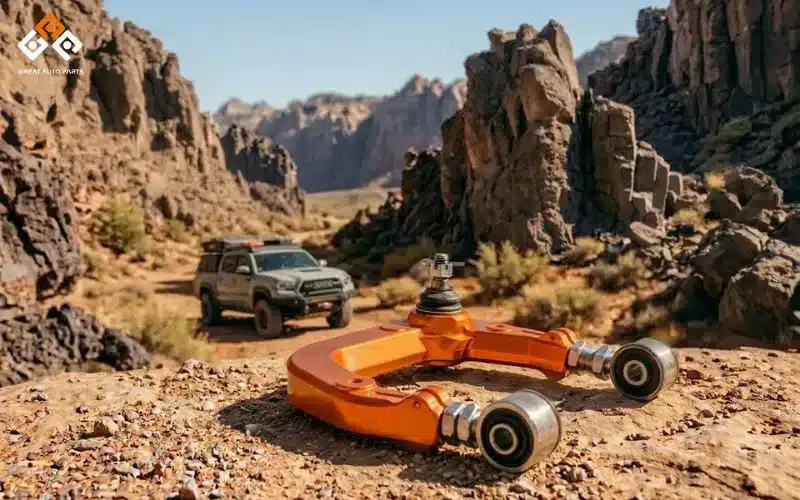
The right choice depends on the brand’s target customer and use case — which is a design decision best made together with a manufacturing partner early in development, not after tooling is locked. You can see this range of construction options on our own adjustable control arms for off-road vehicles product line.
Where the Precision Comes From: Great Auto Parts’ Manufacturing Capabilities
Every lift height, vehicle platform, and joint type combination produces a different correction target — there’s no single caster or camber number that applies universally, which is why we don’t publish one-size-fits-all performance claims. What we can put in front of a sourcing team is process capability, and that’s where Great Auto Parts has invested for over 30 years:
- Vertical integration — forging, sandblasting, precision CNC machining, and assembly are all performed in-house, giving full control over tolerance, cost, and lead time rather than relying on outside subcontractors for critical steps
- IATF 16949 and ISO 14001 certified — process discipline audited to automotive-industry standards, not just a general ISO 9001 baseline
- Smart Factory Management 4.0 with large-scale robotic arms — improves repeatability across production runs and shortens delivery lead times
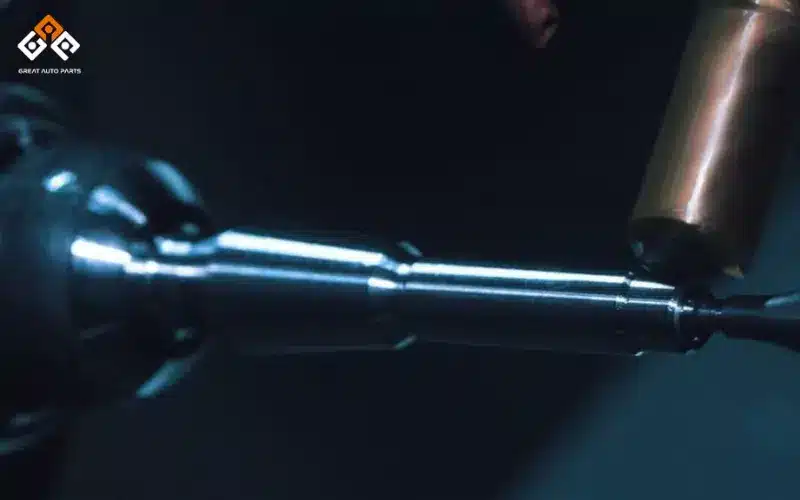
- Ball stud and pillow ball specialization — over 30 years focused on the precision component that sits at the core of every ball joint and control arm pivot, machined and heat-treated in-house
- Laser-etched batch traceability codes — every part traceable to its production batch, which matters when a brand needs to investigate a field return
- R&D reinvestment of over 3% of annual turnover, supporting a catalog of roughly 2,500 items plus 150+ newly developed parts per year
- Control arm prototyping typically in 30 to 60 working days (exact lead time depends on the specific material and tooling requirements), with production MOQs typically in the 300 to 500 piece range depending on product design — built for brands planning production volume around a validated design
For a brand evaluating manufacturing partners, this is the honest way to compare suppliers: not by whose datasheet lists the biggest caster number, but by whose process, certification, and traceability can actually back up the number once the part is in the field. You can review our full certification history on our Certificates & Achievements page.
OEM Manufacturing for Control Arm Brands: Building to Your Specification
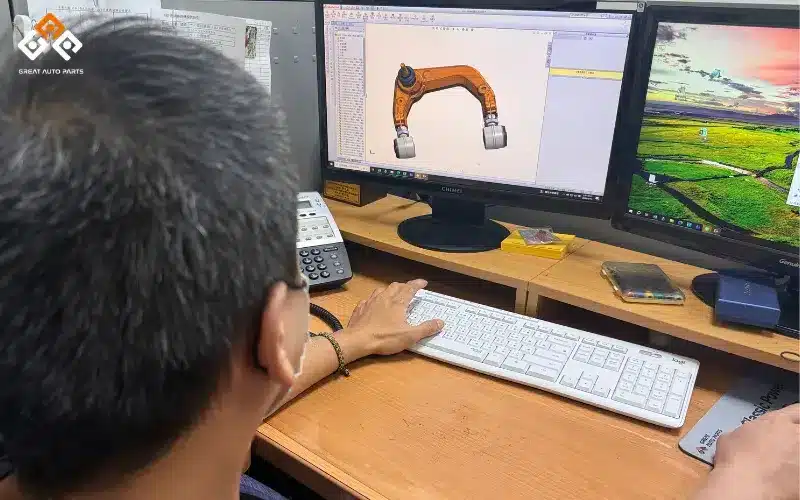
Off-road and lift kit brands that want to offer control arms under their own name typically need a manufacturing partner that can build precisely to a supplied drawing, CAD file, or physical sample — this build-to-print OEM model is where Great Auto Parts’ manufacturing strength lies. Rather than developing geometry correction from scratch, our engineering team works from the brand’s own design or reference sample and focuses on what we do best: precision manufacturing, and identifying opportunities to improve product quality, tolerance, or the machining process along the way.
- Brand provides technical drawings, CAD files, or a physical reference sample for the target control arm
- Great Auto Parts’ engineering team reviews the design for manufacturability and proposes any material, tolerance, or process improvements
- Prototype samples are produced according to the confirmed specification for the brand’s review and approval
- Production tooling is finalized once the brand signs off on sample dimensions and quality
This build-to-print approach lets off-road brands bring their own geometry-corrected designs to market backed by a manufacturing partner with the precision machining and quality process to execute them consistently — with our engineering input focused on manufacturability and process optimization, rather than developing the suspension geometry itself.
Installation and Alignment Considerations
Even a properly engineered lifted-truck control arm requires a professional wheel alignment after installation to fully realize its geometry correction benefits. Installers should also inspect and, where needed, replace related components such as tie rod ends and sway bar end links, since these parts can also be affected by changes in suspension geometry and travel. Torque specifications for ball joint and pivot bolts should always follow the manufacturer’s documentation rather than generic factory service manual values, since fastener sizing can differ between the aftermarket arm and the original equipment part.
Brands developing installation instructions for their customers should also note that alignment should be performed at normal ride height, with a full tank of fuel and no unusual cargo load, and that a re-torque and alignment check after the first several hundred miles catches any settling before it leads to uneven tire wear.
How Aftermarket Brands Evaluate a Control Arm Manufacturing Partner
- Confirm the manufacturer can build precisely to your drawing, CAD file, or reference sample, including the caster/camber correction already designed into it
- Ask whether their engineering team reviews designs for manufacturability and can propose material, tolerance, or process improvements — not every OEM partner offers this
- Ask about material certification, in-house process scope (forging, CNC, heat treatment), and quality system certification (IATF 16949, ISO 14001)
- Request sample lead time and MOQ — this determines how quickly you can validate a new platform before committing to volume
- Evaluate batch traceability and quality documentation, especially if you’ll need it for warranty claims or field investigations
Common Mistakes When Sourcing a Control Arm Manufacturing Partner
- Selecting a manufacturer on unit price alone without verifying IATF 16949 or equivalent quality certification
- Treating an existing competitor part as a design reference without independently validating the geometry against your target lift height
- Overlooking sample lead time and MOQ flexibility, which limits how many platforms you can realistically develop and test per year
- Choosing a supplier without in-house CNC and forging capability, which shifts tolerance risk onto uncontrolled subcontractors
FAQ: Sourcing Insights from a Lifted Truck Control Arm Manufacturer
Q: Do I need new control arms after installing a lift kit?
A: For most lifts beyond roughly 2 inches, yes — stock control arms cannot correct the caster and camber errors introduced by the added height.
Q: What is the difference between fixed-offset and adjustable control arms?
A: Fixed-offset arms are engineered for a specific lift range, while adjustable arms allow fine-tuning of caster and camber across a wider range.
Q: Can a control arm manufacturer provide private label or custom-branded products?
A: Yes — this is Great Auto Parts’ core strength as an OEM manufacturer. Supply your drawings, CAD files, or a reference sample, and our engineering team will manufacture to that specification, offering feedback on manufacturability and quality or process optimization along the way.
Q: How long does it take to get a sample from a new control arm design?
A: For control arms specifically, sample lead time is typically 30 to 60 working days, depending on the actual material and tooling requirements of the design — exact timing is confirmed once the specification is reviewed.
Q: What’s the minimum order quantity for a custom or private-label control arm program?
A: Production MOQs for control arms are typically in the 300 to 500 piece range, though the exact minimum depends on the specific product design.
Q: Is an alignment required after installing new control arms?
A: Yes — a professional alignment is necessary after installation to fully realize the geometry correction the new arms provide.
Q: What certifications should I look for in a control arm manufacturing partner?
A: IATF 16949 for automotive quality management and ISO 14001 for environmental management are strong indicators of process discipline and consistency across production runs.
Conclusion: Your Ultimate Sourcing Guide to Lifted Truck Control Arm Manufacturing
Choosing the right lifted truck control arm manufacturing partner means looking beyond simple lift-height compatibility to confirm that caster and camber correction, ball joint re-angling, and material construction are all properly engineered into the design — and manufactured under a certified, traceable process — for your brand’s specific platform and intended use. A well-designed control arm restores stable steering geometry and even tire wear that a stock replacement arm cannot deliver once a truck is lifted, making manufacturing partner selection — and verification of process certification and sample quality — one of the most consequential decisions in bringing a lift kit product line to market.
Why Partner with Great Auto Parts
For over 30 years, Great Auto Parts has manufactured suspension and steering components for aftermarket brands worldwide — not as a private-label afterthought, but as our core business. When you develop a lifted truck control arm program with us, you get:
- Vertically integrated, certified production — IATF 16949 and ISO 14001 , with forging, CNC machining, and assembly all in-house
- OEM build-to-print manufacturing — work from your drawings, CAD files, or reference sample, with engineering feedback on manufacturability and process optimization
- Realistic planning timelines — control arm prototyping in 30 to 60 working days depending on material and tooling needs, with production MOQs typically 300 to 500 pieces depending on product design
- Traceable, audit-ready quality — laser-etched batch codes and documentation your team can stand behind
Ready to develop a geometry-corrected control arm program for your brand? Contact Great Auto Parts’ engineering team today.