

Understanding Section 232 Tariffs: What U.S. Importers Need to Know About Taiwan Auto Parts
For U.S. auto parts importers, distributors, and aftermarket wholesalers, dealing with changing trade rules is a major business challenge. Trade barriers, rising duties, and supply chain delays often hurt profit margins. Among these policies, the U.S. Section 232 tariffs have historically created big problems for global sourcing plans.
However, recent updates in U.S.–Taiwan trade relations have created a strong advantage for businesses that buy chassis parts from Taiwan. After recent trade talks, specific Taiwan auto parts now enjoy a much lower Section 232 tariff structure. In fact, total duties are now capped at a maximum of 15%. This offers a major cost benefit compared to the high 25% or historic 26.7% rates faced by other countries.
What Is Section 232?
Section 232 of the Trade Expansion Act of 1962 allows the U.S. government to check how specific imports affect national security. Based on these reports, the President has the power to adjust imports using tariffs or quotas.
At first, the government used these rules to protect the domestic steel and aluminum industries. Later, however, officials expanded the scope to look at the wider automotive sector, including passenger cars, light trucks, and key auto parts. The main goal is to protect local factories and keep critical supply chains strong.
How Does Section 232 Affect Automotive Parts?
When you import auto parts into the United States, product classification is everything. Therefore, it does not matter if a part is sold as a steering part, a suspension part, or a general chassis component. U.S. Customs and Border Protection (CBP) always checks the item based on its Harmonized Tariff Schedule (HTS) code.
Most critical safety parts are classified under HTS Chapter 8708, which covers “Parts and accessories of motor vehicles.” Because these items fall directly under trade rules, U.S. importers must watch these codes closely. Otherwise, you might face unexpected penalties at the port. To check live codes and search for matching duties, buyers can easily use the official Harmized Tariff Schedule (HTSUS) Search Tool run by the U.S. International Trade Commission.
aiwan Auto Parts Under the Updated Section 232 Rules
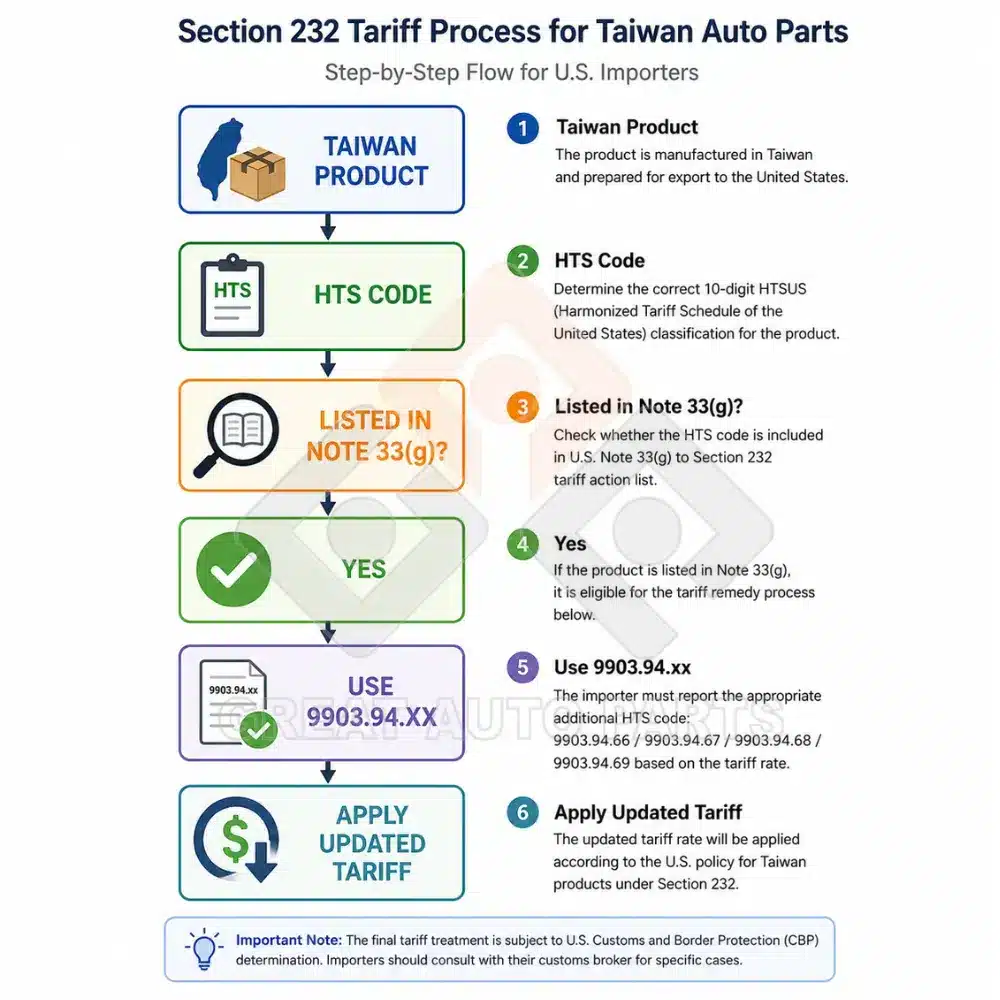
This is exactly where Taiwan-based factories offer a massive financial advantage for North American buyers. Under the updated U.S. customs rules, specifically U.S. Note 33(g), auto parts coming from Taiwan get a lower tariff cap rather than the flat punitive rates applied to other areas.
According to the official trade updates shared by the International Trade Administration of Taiwan, these new customs rules are now active and protect shipments starting from May 1, 2026. Under these specific terms, if a qualifying Taiwan product falls under Note 33(g) and its standard Most-Favored-Nation (MFN) rate is below 15%, the total combined duty is locked at a 15% maximum cap.
To get this lower rate at customs, shipments must be filed using the special trade code 9903.94.67. This code acts as the official key for the low-tariff program. For instance, a part that usually carries a standard 2.5% MFN rate under Chapter 8708 will see its total combined duty drop to 15% when reported under code 9903.94.67. As a result, buyers can easily skip the costly 25% tariffs imposed on competing global hubs.
Expert Insight-Vincent, Global Market Sales Director at Great Auto Parts (20+ Years of Industry Experience): “In a market full of political shifts and trade changes, North American buyers care about two things: reliable supply chains and total costs. The 15% tariff cap under Note 33(g) for Taiwan chassis parts offers a great financial safety net. It helps U.S. importers lower their trade risks without losing the high quality they expect. Therefore, Great Auto Parts has become a great choice for businesses looking to split their supplier risks and improve their import profit margins.”
Section 232 Tariff Examples for Common Steering & Suspension Parts at Great Auto Parts
To help you understand how U.S. Note 33(g) affects your business costs, let us look at a quick real-world example. For most steering and suspension parts, the base MFN duty rate is usually 2.5%.
The table below shows how the total import duty compares under different choices for a $10,000 shipment of chassis parts:
| Sourcing Scenario | Baseline MFN Rate | Section 232 / Subheading Duty | Total Combined Duty Rate | Total Duty Owed (on $10k Value) |
| Scenario A: Non-Mitigated Regions (Global Standard) | 2.5% | +25.0% | 27.5% | $2,750 |
| Scenario B: Taiwan (Filed under Subheading 9903.94) | 2.5% | Restricted by Cap | 15.0% Max Cap | $1,500 |
By switching your orders to a qualified Taiwanese supplier like Great Auto Parts, a U.S. importer saves $1,250 for every $10,000 of cargo value in customs duties alone. Consequently, this big cost reduction gives distributors better pricing freedom to win more customers in the competitive North American aftermarket.
Which Great Auto Parts Products Are Covered?
To help our partners follow these rules and calculate final costs, we match our part numbers directly with official trade codes. Below is a clean list of our main product lines and how they fit into the 2026 tariff rules:
| Great Auto Parts Product | Typical HTSUS | Category | Note33(g) 232 List | Taiwan 2026 Tariff | Recommended 9903 |
| Tie Rod End | 8708.94 | Steering | Covered | 15.0% Max Cap | 9903.94 |
| Rack End | 8708.94 | Steering | Covered | 15.0% Max Cap | 9903.94 |
| Ball Joint | 8708.80 | Suspension | Covered | 15.0% Max Cap | 9903.94 |
| Control Arm | 8708.80 | Suspension | Covered | 15.0% Max Cap | 9903.94 |
| Stabilizer Link | 8708.80 | Suspension | Covered | 15.0% Max Cap | 9903.94 |
Most Great Auto Parts steering and suspension components are classified under HTS Chapter 8708. However, final tariff rates should always be checked by the importer or customs broker based on the actual part code and the live listings on the USITC HTS Database.
Why HTS Classification Matters
A common mistake for many U.S. buyers is relying only on common part names instead of verified trade codes. U.S. Customs does not check duties based on what a part is called in a catalog; instead, they check it using the HTS Code.
Furthermore, to successfully use the Section 232 tariff savings, your customs broker must pair the primary Chapter 8708 code with the matching Chapter 99 clearance code (9903.94.67). For example, a basic ball joint usually goes under suspension systems (HTS 8708.80). However, depending on its design, it might be categorized differently. Similarly, a suspension bushing could fall under HTS 8708 or be classified as a rubber part under HTS 4016. Because of these small details, working with an experienced factory partner is key to staying safe and avoiding costly customs delays.
How Great Auto Parts Supports U.S. Importers
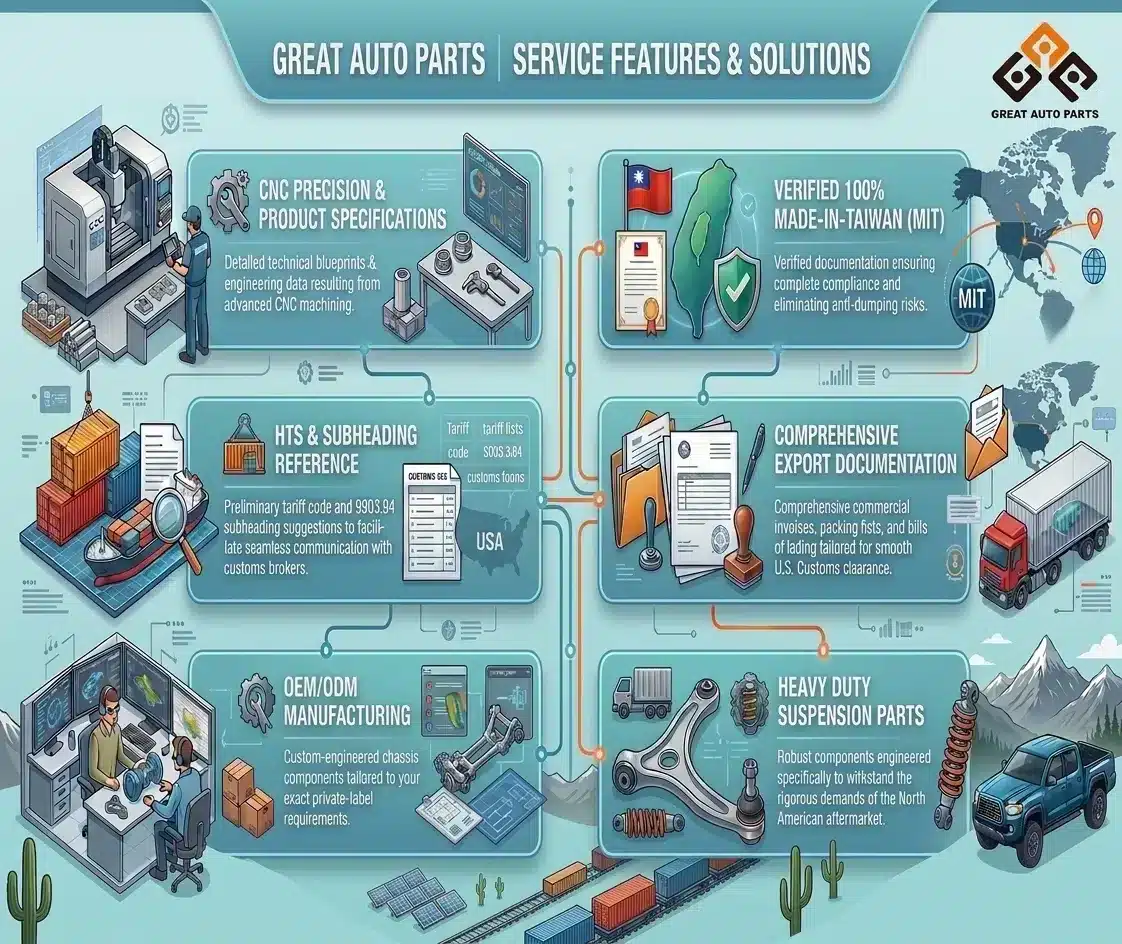
At Great Auto Parts, we do more than just make high-quality chassis parts—we act as a true supply chain partner to make your import process easy. We support U.S. importers by offering:
- Product Specifications: Detailed technical prints and design data from our advanced CNC factories.
- Country of Origin: Official, 100% Made-in-Taiwan (MIT) paperwork to ensure full compliance and eliminate trade risks.
- HTS & Subheading Reference: Smart advice on trade codes and 9903.94.67 filings to help you talk with your customs brokers.
- Export Documentation: Clear invoices, packing lists, and shipping documents for fast customs clearance.
- OEM/ODM Manufacturing: Custom-made chassis parts built to match your private brand needs perfectly.
- Heavy Duty Suspension Parts: Tough components built specifically to handle the rough conditions of the North American auto market.
Frequently Asked Questions Regarding Section 232 on Taiwan Auto Parts
Does Section 232 apply to aftermarket auto parts?
Yes. Section 232 rules apply to both Original Equipment (OE) parts and aftermarket replacement parts, as long as they fall under the target HTS codes.
Are Taiwan auto parts subject to Section 232 tariffs?
Yes, they are within the scope. However, auto parts from Taiwan get a special deal under U.S. Note 33(g), which caps the total duty at 15% to help buyers save money over the standard 25% tariff.
What is the significance of subheading 9903.94.67?
Code 9903.94.67 is the required customs entry code. Importers use it to prove that their Taiwan auto parts qualify for the 15% low-tariff cap program.
What is HTS Chapter 8708?
HTS Chapter 8708 is the official section of the U.S. Tariff Schedule for “Parts and accessories of motor vehicles,” covering steering, suspension, and main chassis setups. For other countries or areas, you should understand What is HS Code here.
How can importers confirm the correct HTS code for Great Auto Parts components?
Buyers should check the factory’s technical specs and blueprints with a licensed U.S. customs broker, or search for live updates directly on the official USITC HTS system.
Do steering and suspension parts qualify?
Yes. Most standard steering and suspension parts—like control arms, tie rod ends, and sway bar links—fall under HTS 8708 and qualify for the 15% tariff cap when made completely in Taiwan.
Conclusion
If you are buying steering or suspension parts from Taiwan, knowing the latest Section 232 tariff rules can help you plan your import costs and avoid customs delays. Great Auto Parts supplies high-quality steering and suspension parts for global aftermarket customers and can provide product specifications and export documentation to support your import process.
[Contact Great Auto Parts Today to Request a Quote and Optimize Your Supply Chain]