

Do You Need Upper Control Arms After a Lift? How Lifting Changes Camber and Caster on IFS Trucks
Quick Summary
Lifting an IFS truck pushes camber positive and reduces caster. Whether you need aftermarket upper control arms depends on one thing: can your alignment shop bring both back into spec with the factory adjustment range?
- What Happens to Front Geometry When You Lift an IFS Truck
Lifting pushes camber positive, reduces caster, and moves the upper ball joint closer to its angle limit. - Signs Your Lifted Truck’s Geometry Is Off
Wandering points to low caster. Outer-edge tire wear points to positive camber. Your alignment sheet confirms which. - When Factory Upper Arms Run Out of Adjustment
Up to about 1.5 inches of lift, most trucks can be aligned with the factory arms. Beyond that, camber and caster start competing for the same adjustment. - What a Geometry-Correcting Upper Control Arm Should Do
A good replacement arm restores caster, allows camber adjustment, gives the ball joint more articulation, and holds up off-road. - Quick Decision Guide: Stock Arms or Upgrade?
Match your alignment results to the right next step. - Lifted Truck Camber and Caster FAQs
Lift height, KPI vs. camber, alignment after install, and solid axle trucks. - The Bottom Line: Let the Alignment Numbers Decide
Read the alignment numbers first, then choose parts.
You lifted your truck, and now it wanders on the highway, the steering feels vague, or the outer edges of your new tires are wearing faster than they should. The usual forum answer is “you need upper control arms.” Sometimes that is right. Sometimes it is not.
Here is the short version: lifting an independent front suspension (IFS) truck pushes camber positive and reduces caster. Whether you need aftermarket upper control arms depends less on how many inches you lifted and more on one question: can your alignment shop bring both camber and caster back into spec with the factory adjustment range?
Below, you’ll see what changes in your front geometry, how to spot the symptoms, how to read your alignment sheet, and what a geometry-correcting upper control arm should actually do.
What Happens to Front Geometry When You Lift an IFS Truck
When you lift an IFS truck with spacers or taller coilovers, the body rises but the tires stay on the ground. That forces the upper and lower control arms to hang at a steeper downward angle. This is the same position the suspension would normally reach only in droop. Three things change as a result: camber goes positive, caster decreases, and the upper ball joint works closer to its angle limit.
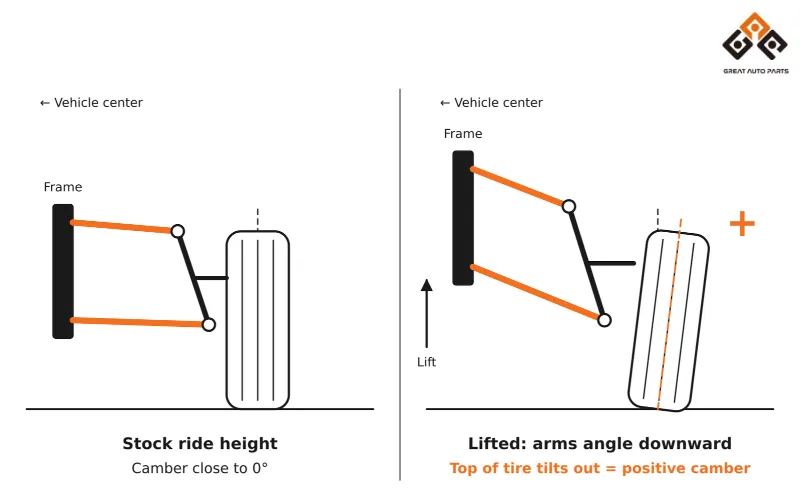 Stock ride height (left) vs. lifted (right), front view. As the arms angle down, the top of the tire tilts outward. Angles exaggerated for clarity.
Why short-long arm (SLA) suspension changes camber as it droops
Most pickups and body-on-frame SUVs, including the Tacoma, Hilux and Fortuner, use a double wishbone front suspension with a short upper arm and a long lower arm. Engineers call this short-long arm (SLA) geometry. The difference in length is intentional.
Because the upper arm is shorter, it swings through a tighter arc than the lower arm. When the suspension compresses, such as the outside wheel in a corner, that tighter arc pulls the top of the steering knuckle inward. The tire leans in (negative camber), which helps keep the tread flat on the road as the body rolls.
A lift reverses this. With the arms parked lower, the suspension sits in the part of its travel where the top of the knuckle moves outward relative to the bottom. The tire leans out at the top. That is positive camber, and it is the most common alignment problem on lifted IFS trucks.
Why caster drops as the upper arm angle steepens
Caster is the tilt of the steering axis when you look at the wheel from the side. With positive caster, the upper ball joint sits slightly behind the lower ball joint. It works like the front wheel of a shopping cart: it gives the truck straight-line stability and helps the steering wheel return to center after a turn.
On most IFS trucks, the upper arm does not pivot on a perfectly horizontal axis. As the arm swings down after a lift, the upper ball joint also moves forward relative to the lower one. Moving the top of the steering axis forward reduces caster. The more you lift, the more caster you lose.
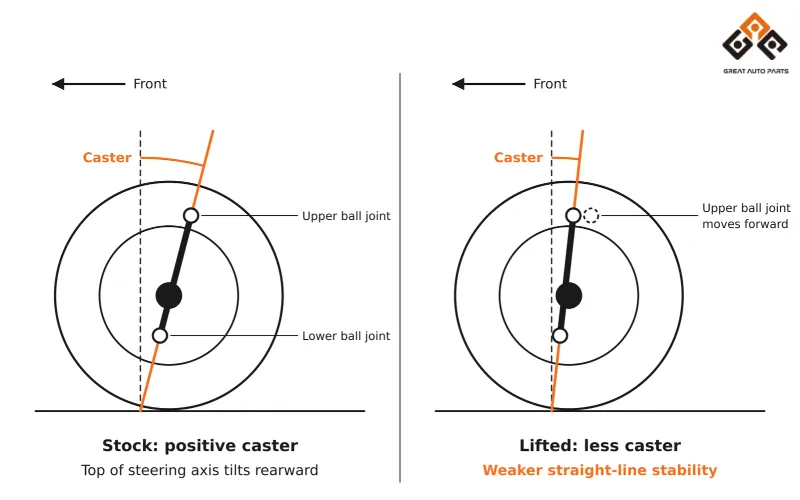 Side view. The steering axis runs through the upper and lower ball joints. After a lift, the upper ball joint moves forward and the caster angle shrinks. Angles exaggerated for clarity.
Ball joint angle: the change most owners don’t see
The upper ball joint is designed to work within a certain range of angles. A lift moves its starting point closer to the end of that range, so when the suspension drops further, for example when a front wheel falls into a hole off-road, the joint can reach its limit. At that point the ball stud binds against the housing. This speeds up wear, and in extreme cases it can damage the joint.
You will not feel this on the road. You will only see it as wear, a torn boot, or a loose joint at your next inspection.
So how do you know whether these changes are actually hurting your truck? Start with how it drives, then confirm with the alignment numbers.
Signs Your Lifted Truck’s Geometry Is Off
The two main geometry problems after a lift show up in different ways. Too little caster mostly affects how the truck drives. Too much positive camber mostly affects how the tires wear. Telling them apart tells you which number to look at first.
Wandering and weak return-to-center = caster
If the truck needs constant small steering corrections on the highway, feels “floaty” above 60 mph, or the steering wheel is slow to return to center after a turn, low caster is the most likely cause. Low caster usually does not cause unusual tire wear, which is why many owners live with it for a long time without realizing it can be fixed.
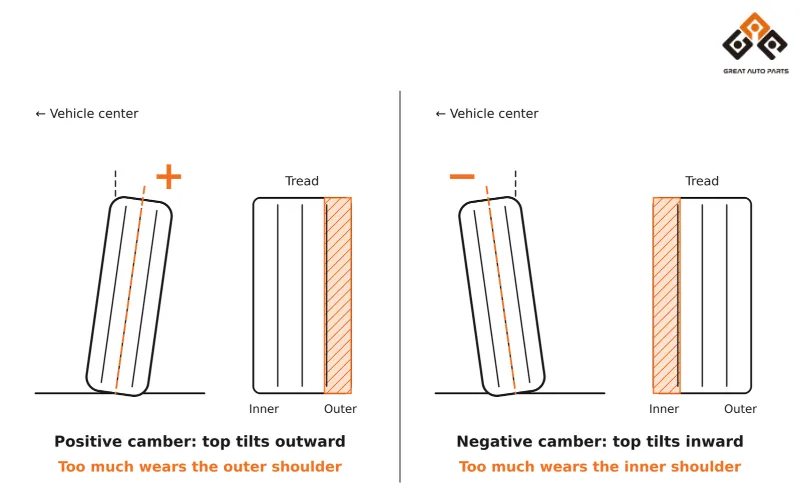
Outer-edge tire wear = positive camber
If the outer shoulders of the front tires are wearing faster than the center and inner edge, look at camber. On larger all-terrain and mud-terrain tires this matters more, because the tires are expensive and the wear shows up quickly on aggressive tread blocks. You may also see the tops of the front tires tilting outward when you stand in front of the truck.
How to read your alignment sheet
Shops with a computerized alignment machine can print a report that shows camber, caster, and toe for each wheel, usually with “before” and “after” readings next to the factory specification range. Many shops hand it over automatically. If yours doesn’t, ask for it. For a lifted IFS truck, focus on these three items:
| What to check | What it tells you | What to watch for |
|---|---|---|
| Front camber (left and right) | Tire tilt in or out | Positive values at or past the edge of the factory range |
| Front caster (left and right) | Steering stability and return-to-center | Values at the low end of the factory range |
| Left-to-right difference | Whether the two sides match | A large difference can make the truck pull to one side |
Some reports list the left-to-right difference as “cross-camber” and “cross-caster.” If yours doesn’t, compare the left and right numbers yourself. Most reports also color-code each reading against the factory range for your model and year. A green “in spec” mark is not the full story. Ask the technician one question: “Did you have to max out the adjusters to get here?” If the answer is yes, the shop may have traded one number for the other, usually giving up caster to get camber into range.
When it’s not the arms: seized cam bolts and other false alarms
Before you buy anything, rule out the simpler causes. On many trucks, camber and caster are set with cam bolts on the lower control arm mounts. If those bolts are rusted or seized, the shop cannot use the full adjustment range, and the truck may look like it “needs upper arms” when it really needs freed-up or replaced cam bolts.
Also check for worn ball joints, worn control arm bushings, or tie rod ends with play. Any of these can cause wandering or uneven wear that looks like a geometry problem. New arms will not fix a worn part somewhere else.
If those parts are healthy and the shop still cannot get both numbers into range, the factory upper arms have most likely reached their limit.
When Factory Upper Arms Run Out of Adjustment
Factory upper control arms run out of adjustment when the lift has moved camber and caster further than the factory cam bolts can correct at the same time. At small lifts the shop can usually bring both back into range. As the lift increases, the shop has to choose which one to fix, and that is the point where aftermarket arms start to make sense.
The trade-off: getting camber right by giving up caster
On many IFS trucks, the same set of adjusters controls both camber and caster. Moving them to pull camber back toward zero often reduces caster, and the reverse is also true. With a mild lift there is enough room to satisfy both. With a larger lift, a typical result is camber in spec and caster at the bottom of the range, or caster acceptable and camber still positive.
This explains a common complaint: “My alignment sheet says in spec, but the truck still wanders.” Camber was fixed first, and caster paid the price.
How much lift factory upper arms can handle
As a general guide, up to about 1.5 inches of front lift, most trucks can be aligned back into spec with the factory upper arms. Beyond that point, caster often starts to fall toward the low end of the range, and the shop has less room to correct camber without giving up caster. The larger the lift, the more likely aftermarket arms become.
Treat that range as a starting point, not a rule. The real answer depends on:
- Your exact model and generation. Different trucks have different arm geometry and adjustment ranges.
- How the lift was done. Coilovers set at their highest setting, spacers, and adjustable struts can end up at different ride heights than the advertised number.
- The condition of your adjusters. Seized cam bolts reduce the usable range.
- Your priorities. A truck used mainly on the highway needs good caster more than a truck that crawls trails at low speed.
Clearance problems: arm-to-coil contact at full droop
Geometry is not the only limit. On some lifted trucks, the factory upper arm can contact the coil spring or coilover body when the suspension drops to full droop. Larger tires can also rub the inner fender or body mount as the suspension cycles through its travel. If you see rub marks on the arm, the spring, or the fender liner, the factory arm shape is becoming a physical limit, not just an alignment limit.
If your truck shows these signs, the next question is what a replacement arm should actually fix.
What a Geometry-Correcting Upper Control Arm Should Do
A geometry-correcting upper control arm should solve the specific problems a lift creates: it should let you restore caster, give you room to bring camber back to target, allow the ball joint to work through the extra droop, and stand up to off-road loads. If an arm only looks stronger but does not address these four points, it will not change how your truck drives.
Restore caster through ball joint position
Caster depends on where the upper ball joint sits relative to the lower one. A well-designed aftermarket arm changes the position of the upper ball joint, either with a fixed offset built into the arm or with an adjustable mechanism, so the alignment shop can bring caster back up without giving up camber. When comparing arms, ask how caster is gained and whether it is fixed or adjustable.
Make camber adjustable, ideally on the vehicle
Every truck, lift, and tire combination ends up a little different. An arm with camber adjustment gives the alignment shop more room to hit the target. Adjustment that can be made with the arm installed saves time on the alignment rack. It also lets you fine-tune later, for example after adding a heavy front bumper or winch, which compresses the front suspension and moves camber toward negative.
Give the ball joint more articulation range
Since a lift moves the upper ball joint closer to its angle limit, the replacement arm should use a joint with enough articulation for lifted droop. Check the published articulation angle, whether the joint can be greased, and whether it can be replaced separately when it wears, instead of replacing the whole arm.
“On a lifted truck, the upper ball joint starts out closer to its limit, so articulation is the first thing I look at in any design. Our joint is designed for ±35°, 70° in total, to give it room to follow the suspension into full droop without the stud binding against the housing. The second thing is grease. Off-road, water and mud eventually get past any boot. With a greasable joint and machined grease grooves, fresh grease can reach the whole ball surface and push contaminants out. And if the joint does wear, you replace the joint, not the whole arm.”
— Mike, Product Design Engineer, Great Auto Parts Engineering Team
13 years in auto parts design
Build for off-road loads: material, finish, serviceability
Off-road use adds impact loads, water, mud, and road salt. Look at how the arm body is made (forged or fabricated), what material it uses, how the surface and hardware are protected from corrosion, and what boot material seals the ball joint.
Example: GAP adjustable front upper control arm kit for Tacoma, Hilux and Fortuner
Here is how the GAP Adjustable Front Upper Control Arm Kit (OE 48610-04020) addresses the four points above:
| Requirement | GAP CATY-2201KIT |
|---|---|
| Caster and camber adjustment | Turnbuckle mechanism adjusts camber and caster on the vehicle, without removing the arm. A custom hex wrench is included. |
| Ball joint articulation | Heavy-duty metal-to-metal ball joint with ±35° articulation (70° total) |
| Serviceability | Ball joint is greasable, with machined grease grooves, and replaceable separately from the arm. M14 × 1.5 ball stud thread. |
| Arm body | Precision-forged 6061-T6 aluminum, orange anodized |
| Corrosion protection | Trivalent white zinc-plated hardware; chloroprene rubber (CR) ball joint dust boot |
| Lift range | Designed for 1.5″–3.0″ suspension lifts |
| Fitment | Tacoma 2nd Gen 2005–2015 (4WD/PreRunner), Tacoma 3rd Gen 2016–2023, Hilux Vigo 2005–2015, Hilux Revo 2015–2025, Fortuner 2005–2015 and 2015 onward |
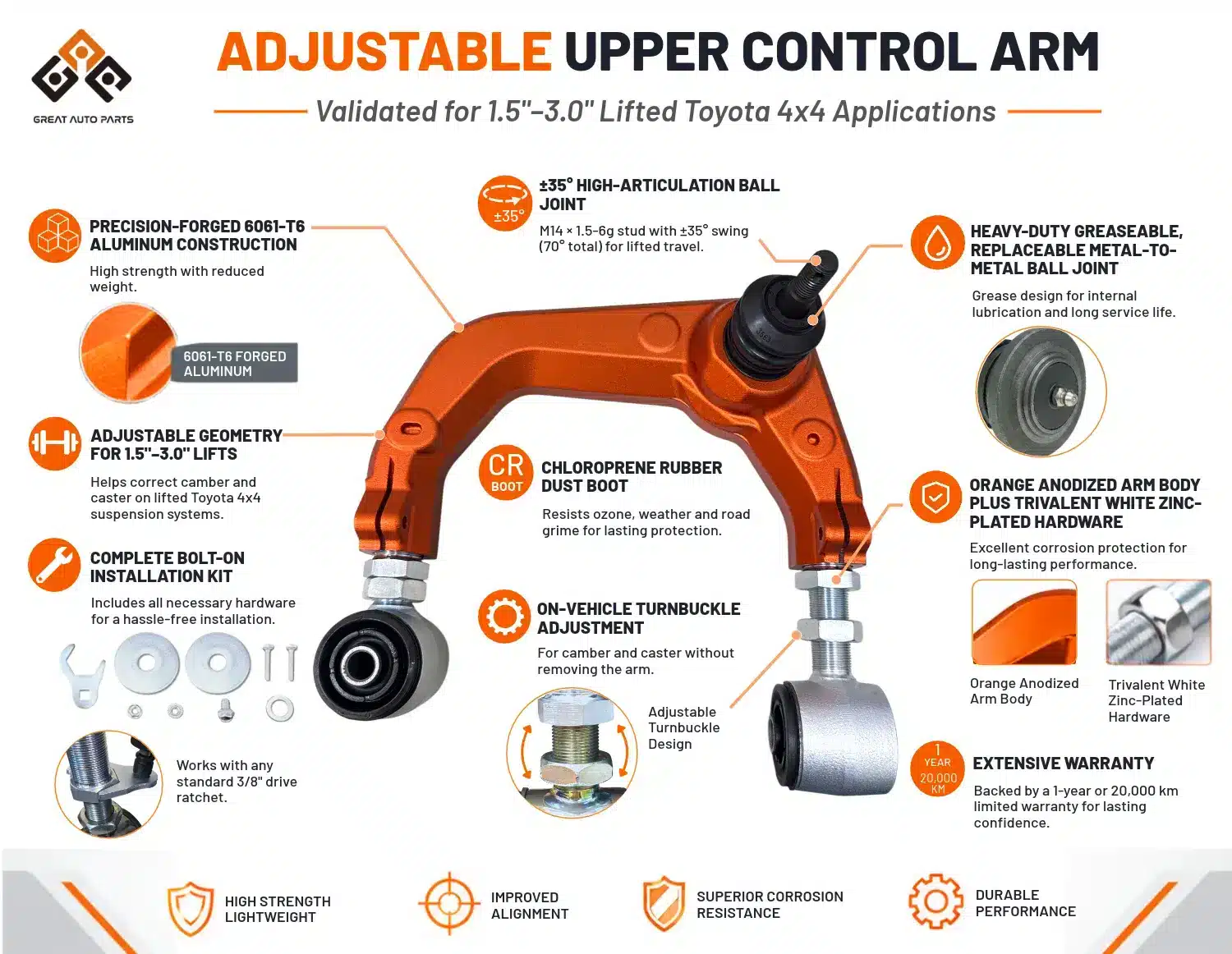
GAP adjustable front upper control arm kit (CATY-2201KIT), sold as a left and right pair.
The arms are sold as a left and right pair and are made in Taiwan. As with any upper control arm, the final camber and caster values depend on your truck, your lift, and your alignment. Always have a full alignment done after installation, and confirm the final numbers on the printout.
Quick Decision Guide: Stock Arms or Upgrade?
Use this table with your alignment sheet in hand:
| Your situation | Likely answer |
|---|---|
| Mild lift, camber and caster both in spec, adjusters not maxed out, truck tracks straight | Keep the stock arms. |
| Camber in spec, but caster at the low end and the truck wanders | Consider aftermarket arms, especially if you drive mostly on the highway. |
| Camber still positive with adjusters maxed out | Aftermarket arms are likely needed. Check cam bolts first. |
| Rub marks on the arm, coil spring, or fender liner at full droop | Aftermarket arms are likely needed for clearance. |
| Uneven wear or wandering, but the shop reports worn joints or bushings | Fix the worn parts first, then realign and reassess. |
Lifted Truck Camber and Caster FAQs
Q: Can I install aftermarket upper control arms on a truck with only 1.5″ of lift?
A: Usually yes, if the arm is designed for your lift range. At around 1.5 inches, owners often choose them to restore caster for better highway stability. Check the manufacturer’s recommended lift range, since arms built for larger lifts may not align well at stock height.
Q: Is KPI (kingpin inclination) the same as camber?
A: No. Camber is the tilt of the tire. Kingpin inclination (KPI, also called steering axis inclination or SAI) is the tilt of the steering axis through the ball joints. KPI is usually not adjustable. An unusual KPI reading often points to a bent part.
Q: Do I still need an alignment after installing new upper arms?
A: Yes. Replacing the upper arms changes camber, caster, and toe. The truck needs a full alignment immediately after installation. It is also worth rechecking after the first few hundred miles, because new springs and bushings can settle.
Q: Do lifted solid axle trucks need upper control arms?
A: Not in the same way. On solid front axle vehicles such as the Jeep Wrangler or Suzuki Jimny, camber barely changes with lift. The main corrections are caster and keeping the axle centered side to side.
The Bottom Line: Let the Alignment Numbers Decide
Lifting an IFS truck always moves camber positive and reduces caster. Whether that becomes a problem depends on whether the factory adjustment range can correct both at the same time. Get a full alignment, read the before and after numbers, ask whether the adjusters were maxed out, and rule out seized cam bolts and worn parts. Then decide.
If the numbers show your factory arms have reached their limit, see the GAP Adjustable Front Upper Control Arm Kit for Tacoma, Hilux and Fortuner. For distributor, private label, or OEM/ODM inquiries, contact us.